
Good Software Is About Simplifying Things, Not Adding More Features
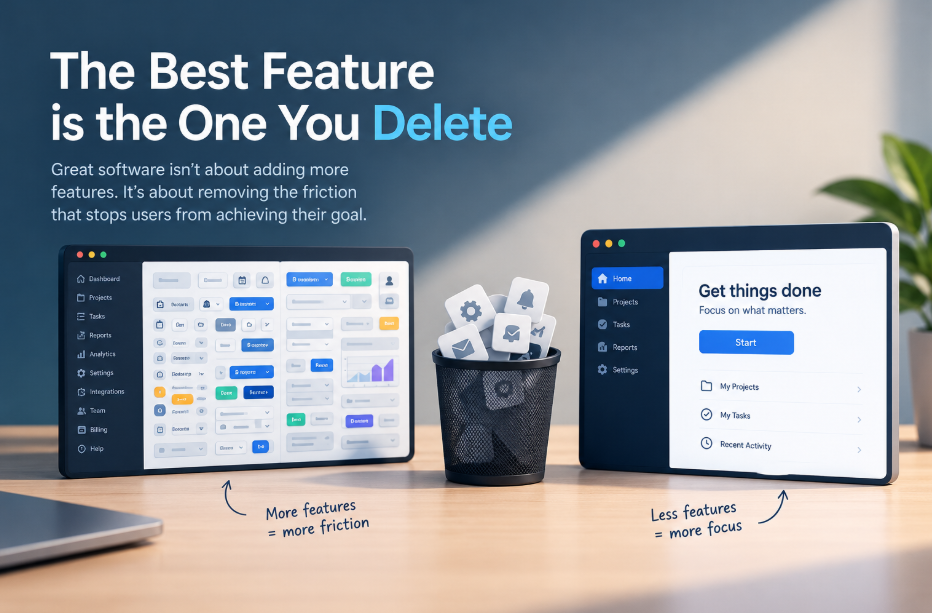
It’s easy to assume that the more features a product has, the better it must be. More buttons, more settings, more options. It can look like progress, but does it actually make the software better?
Not always.
Good software isn’t about giving users more things to click. It’s about helping them get things done with less effort.
More Features Don't Always Mean Better Software
Every new feature adds something to a product. It might solve a problem, save time, or make a task easier. But it can also introduce another setting to understand, another decision to make, or another step to complete.
Think about a simple task that takes five clicks in one application but only two in another. Both applications might offer the same result, but one makes the user work harder to get there.
That difference matters.
Users don't open software because they want to explore every feature. They open it because they have something to do. They want to send an invoice, manage a project, find information, or complete a task without fighting the interface.
When a product becomes complicated, even small tasks can feel like work.
Simplicity Takes Engineering
Making software simple isn't always easy. In fact, it often requires more thought than adding another feature.
As developers, we naturally look for ways to solve problems with code. When someone requests a new option, it's tempting to build it. When we discover another possible use case, we might add another setting to cover it.
But good engineering also means asking whether that option needs to exist in the first place.
Can the system handle this automatically? Can we remove a step? Can we make the default behaviour good enough that most users never need to change it?
Sometimes, the best solution isn't another function or configuration option. It's a better approach to the problem.
The goal isn't to hide useful functionality. It's to make the software easier to understand and use.
Every Extra Decision Has a Cost
Imagine opening a dashboard and finding twenty filters, twelve buttons, and several settings before you can complete a basic task.
Some users might appreciate that level of control. Others will wonder where to start.
Each additional choice asks the user to spend time understanding what it does and deciding whether they need it. When those choices don't provide meaningful value, they become unnecessary friction.
This is especially important in business software. People use these systems throughout the day, often while handling several other responsibilities. A confusing workflow doesn't just create frustration once. It can waste time every time someone repeats the task.
A well designed product reduces that burden. It presents the right options at the right time and lets users focus on their work rather than the software itself.
Build for the User's Goal
Before adding a feature to the next release, I think it's worth asking a few simple questions.
What problem does this feature solve?
A feature should address a real user need, not just make the product look more advanced.
Will it make an existing task easier?
If users need more steps to achieve the same result, the feature might introduce complexity without providing enough value.
Can we solve the problem without adding another option?
Sometimes a better default, a clearer interface, or an automated process can solve the problem more effectively.
Will users actually use it?
Not every possible use case deserves a permanent place in the interface. Some features are useful to a small group, while others add complexity for everyone.
These questions won't always lead to the same answer. Some products genuinely need advanced controls and extensive functionality. The important thing is to make those decisions based on user needs rather than the desire to keep adding things.
Simplicity Doesn't Mean Removing Everything
There is a difference between simple software and limited software.
A product can offer powerful functionality while remaining easy to use. The complexity can exist behind the scenes, where the system handles it without forcing users to understand every technical detail.
For example, a user shouldn't need to understand how a background process works just to upload a file. They shouldn't need to configure ten different settings to complete a routine task.
Good software takes care of the complexity that users don't need to manage.
That doesn't mean removing advanced features that experienced users depend on. It means organising them properly, choosing sensible defaults, and keeping the main workflow clear.
The best products often give beginners a straightforward experience while still allowing experienced users to do more when they need to.
Sometimes, the Best Feature Is the One You Don't Build
As developers, we spend a lot of time thinking about what we can build next. We discuss new functionality, plan releases, and look for ways to expand our products.
But there's another question worth asking: what can we leave out?
Not every request needs a new feature. Not every edge case needs another setting. Not every improvement requires more code.
Sometimes, the right decision is to simplify an existing workflow, remove an unnecessary step, or leave the interface exactly as it is because it already does the job well.
That kind of decision might not look impressive in a release announcement, but users can feel the difference.
They finish their work faster. They make fewer mistakes. They spend less time figuring things out.
And that's a meaningful measure of good software.
Final Thoughts
I believe good engineering is about finding the simplest solution that solves the problem properly.
Before adding something to your next release, ask yourself whether the user really needs it or whether you're simply making the product bigger.
More features can increase capability, but they don't automatically increase value. Sometimes, removing friction makes a bigger difference than introducing something new.
The best software isn't necessarily the software that does the most. It's the software that helps people get things done with the least unnecessary effort.
And sometimes, the best feature you can build is the one you ultimately decide not to build.
#SoftwareEngineering #ProductDesign #BuildInPublic #UX #Minimalism #TechStrategy #DigitalTransformation